Will AI replace consultants? Behind the consulting desk with Kak Edvin
Written by Indah Ramadhani (STI'24)in Department of External6 min read24 Nov 20261 view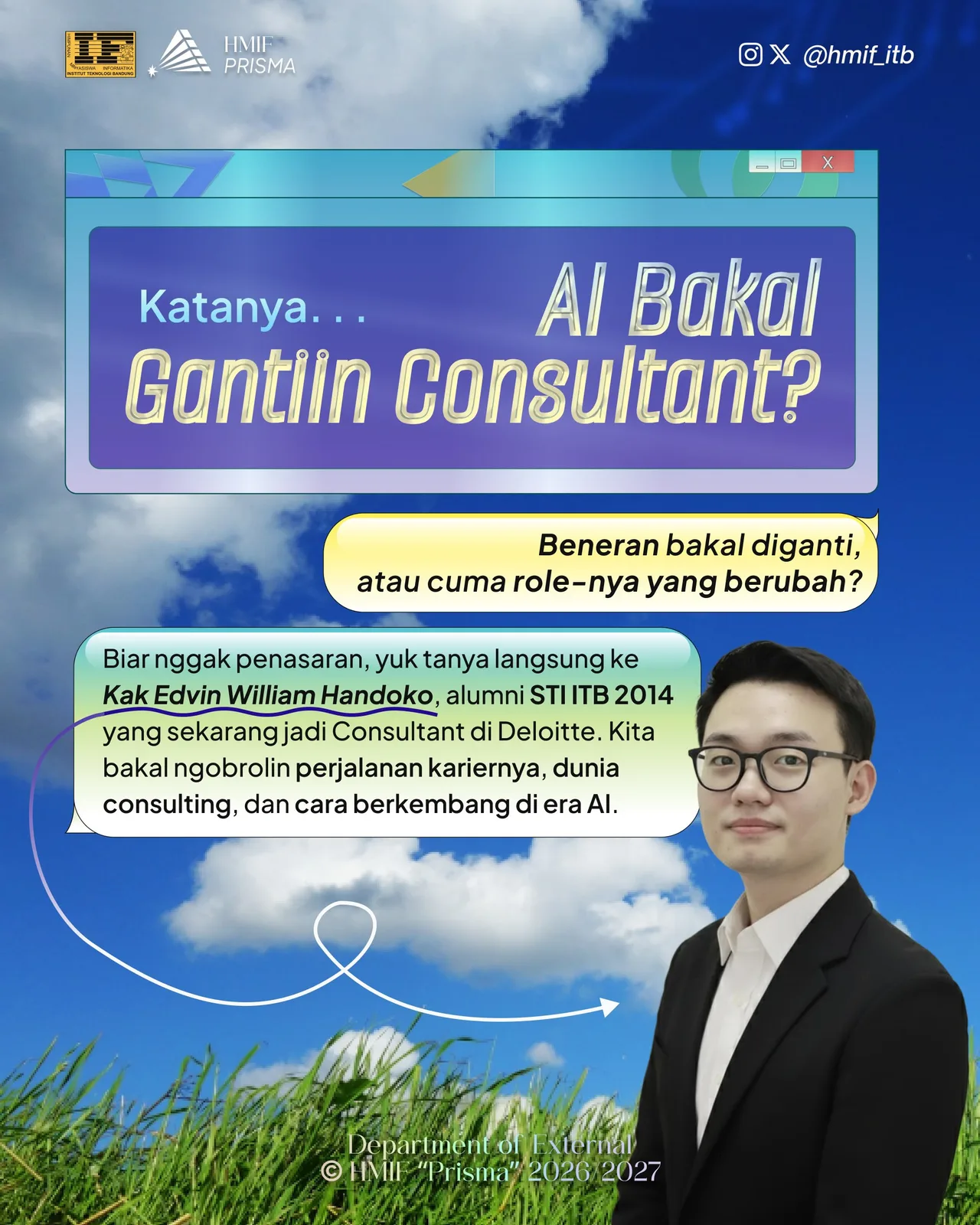
Will AI really replace consultants, or will only the role change? At Alumni Connect, HMIF members talked with Kak Edvin about his career, the world of consulting, and how to grow in the AI era. This recap was first posted in Indonesian on HMIF's Instagram, and this is its English translation.
It was not a grand plan
Did you already plan a master's abroad during university?
Not that ambitious. I only thought about it after graduating. A master's seemed fun, since I could travel and broaden my horizons.
You were a teaching assistant. Were you aiming for academia?
I just like helping friends and juniors learn. At ITB I felt really helped by the teaching assistants, so I wanted to help too. During my master's, I was a teaching assistant to help with mentoring.
I was helped once, so I want to help too.
Consulting is for generalists
Are any STI courses useful in consulting?
It depends on the role, but consulting is generalist by nature. What I use most are the courses about working with users, gathering requirements, and managing people.
What does an IT consultant's work cover?
It can be management strategy or implementation. These days the two have started to blend, as at Deloitte.
Implementation varies too, from the application development life cycle to technical work like AI consulting.
Competitions, CVs, and connections
How much did being an assistant and joining competitions help you get a job?
It helps a little. Recruiters rarely ask whether you were an assistant or which competitions you joined, but they look through your CV for something interesting to ask about.
Network and experience matter more than competitions, because sometimes a person offers you a job out of the blue.
Did you ever win a competition?
Yes, but not often. I mostly joined project management and business case competitions, like PMC, since they suited me better than programming.
What do you mean by network here?
It is simple. Widen and multiply your connections. The more exposure you get, the more layers your circle has, from your closest friends to people you barely know.
As friends, just be friends. As professionals, exchange names and contacts, and meet now and then to stay in touch.
Cracking business case competitions
Is there a strategy to win business case competitions, now that AI can give solutions?
I have never won a business case competition myself. But:
There is a format to follow, such as the executive summary and the presentation. Ask friends who have joined one.
Judges assess your line of thinking, how well you answer the problem. At INFEST, the judges were finance people, yet they did not look at the finance numbers.
Everyone uses AI, my company included. What matters is how you use it, because AI cannot frame the problem for you.
Define the problem well, so the solution can be sped up with AI.
AI is a machine that learns from the data that already exists.
Using AI the smart way
What data may we give to AI?
If you upload to a general AI, the data goes into their database. You can use Gemini or Claude, but the enterprise versions.
It is not only about code. Even when you meet friends in the same line of business, you must not reveal too much.
Inside the consulting desk
What is the difference between an independent consultant and one tied to a company?
Only the company name. At the Big Four or the Big Three, you are technically an employee of the company, but you work for a partner. Partners find and approach clients, so your real boss is the partner.
A company usually does not let you take the same client to another company in that field.
Is a partner the same as a client?
No. A partner is the highest position in a consulting firm, the one who brings in business under the Deloitte name. Administration goes through Deloitte, but the partner pays the consultants, so it is like being a CEO.
Outside consulting, most places use C-level titles. Law firms and consulting use the term partner. Changing partners is like changing companies.
Why companies hire consultants
Why do banks still need consultants when they have their own divisions?
Usually for large-scale projects. In Indonesia each division has its own work, while consultants cut across those fields.
What do consultants actually do?
It depends on the project. The process has presales, to understand the project, then sales, then the project itself. A consultant can execute end to end, or only the strategy.
What is industry's problem now, and where can IF and STI students fill the gap?
Small and medium enterprises have not changed much yet, while big companies are already moving toward AI.
IF and STI students surely have AI literacy, and that can fill the gap.
Roles are getting blurry
Could AI replace consultants?
Not 100 percent, but roles are getting blurry. There are now forward deployed engineers who gather requirements, design, and build on their own.
If AI can help with everything, are PMs still needed?
The question is no longer whether a role gets replaced, but how it gets redefined.
A PM does not just connect two sides. They must understand the technical side, closer to a product owner.
Agentic AI is the trend now, helping us work in our own way.
Which soft skills should we develop?
If you can, take them all, from public speaking and critical thinking to leadership. You do not have to master everything. What matters is getting exposure first.
Always the new kid
Have you had cases you were not familiar with?
All the time. Each project can have a different tech stack. I once worked at an Indonesian telco and then moved to Thailand, and everything was different.
To catch up, keep learning and use the knowledge base.
How did you return to industry after a career break?
In Indonesia a career break is not common yet, so I showcased my experience and what I could do.
How did you get your first job in Singapore?
I started in Bandung as a business analyst, then moved to Singapore because of COVID. It depends on the role. Engineers are judged on their tech, while PMs and BAs are judged on their domain.
Do internships matter a lot?
Not much, but it is valuable. They look at how we worked at the time.
Mentors, habits, and growth
Does a mentor matter, and how did you find one?
Your first job can set the rhythm for the next. My mentor was two levels above me, and I found them by accident.
Choose your role model wisely, because if your role model is relaxed, you will be too.
Be grateful when there is someone who can nurture you.
How do you hold up when work gets heavy?
Keep a healthy diet and good rest, not staying up late with Netflix or gaming. I also run 5K regularly.
Was your year very active?
My year was not very active, but every year still caught up. In the association I was in Academic and in the DPP.
Do you regret anything?
Nothing, but I wish I had made friends more widely and been less afraid to try. I used to be an introvert and often skipped opportunities.
What is your message for second and third-year students?
Don't give up. An ocean of exams is normal. Campus is a place to make mistakes, so don't be afraid to try.
A career is not a straight line. It is about learning and daring to try. Seize the opportunity, and keep a knight's spirit. Thank you, Kak Edvin William Handoko!
Credits
- Content writer
- Indah Ramadhani (STI'24)
- Graphic designer
- Amanda Trishya Aulia (STI'24)
Alumni Relations division, Department of External, HMIF ITB 2026/2027